Home › Common Problems › Countertop Separation from Wall
Countertop Separation from Wall
in Austin, TX
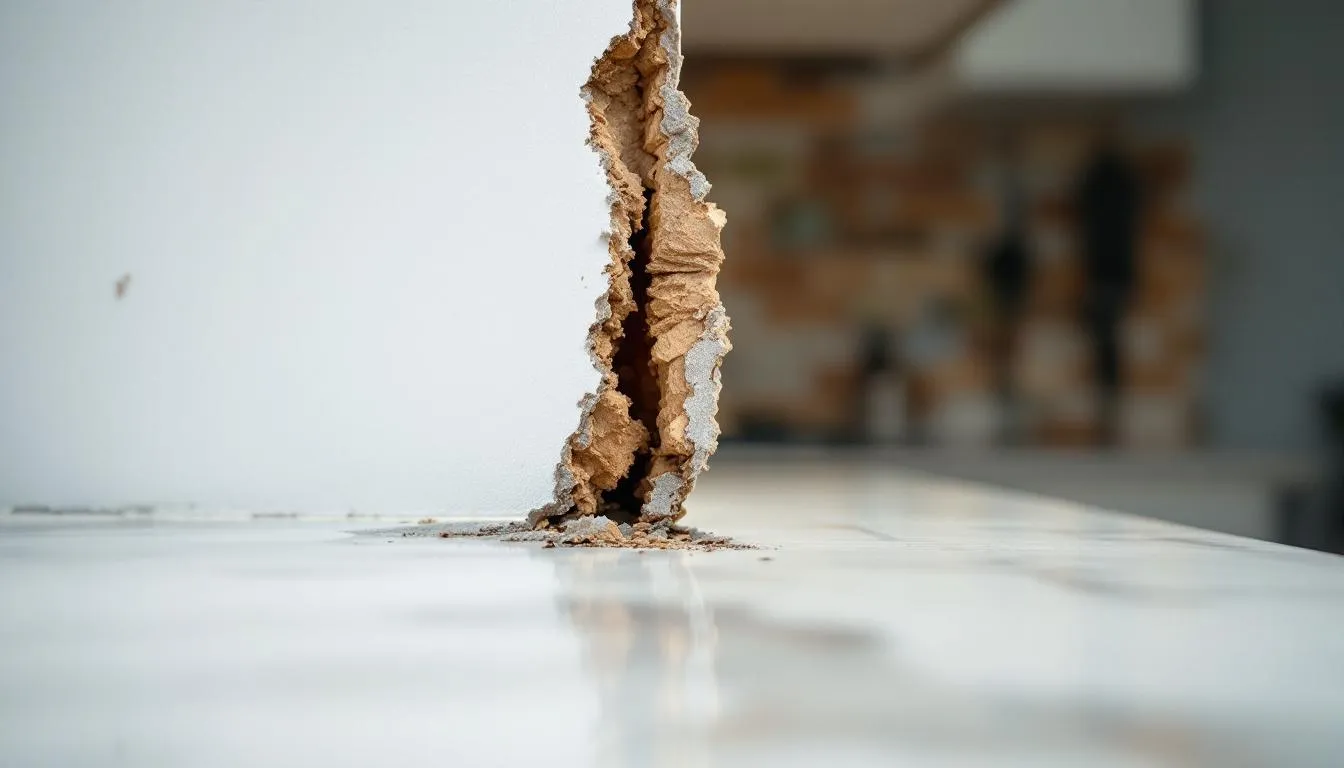
A gap opening between a kitchen countertop and the wall is a cosmetic nuisance that homeowners in Austin often misread as a simple caulking problem, when it frequently signals ongoing foundation movement driven by the city's reactive clay soils. As Austin's Houston Black Clay expands and contracts through wet and dry cycles, even a well-engineered post-tension slab shifts enough to pull a rigidly installed countertop away from the wall over time. Left unaddressed, the gap allows cooking grease, moisture, and debris to collect behind the countertop, creating sanitation issues and accelerating damage to drywall or tile backer in the backsplash zone.
Telltale Signs
Warning Signs to Watch For
- Visible gap of 1/8 inch or more between the countertop back edge and the wall or backsplash
- Old caulk in the countertop-to-wall joint is cracked, compressed, or missing entirely
- The gap is wider at one end of the counter run than the other, indicating differential movement
- Countertop surface is visibly not level — water pools toward the back or toward one side
- Backsplash tile grout is cracked along the bottom course directly above the counter
Root Causes
What Causes Countertop Separation from Wall?
Foundation Settlement from Clay Shrinkage
During Austin's extended dry periods — particularly the brutal summers that regularly go weeks without measurable rain — the clay soil beneath slab foundations loses moisture and contracts, causing sections of the slab to drop. When the cabinet base and countertop drop with the slab but the wall framing moves independently, the rigid countertop pulls away from the wall leaving an increasing gap.
The Fix
Foundation Moisture Management and Countertop Recaulking
Establishing a consistent drip-irrigation perimeter around the foundation to maintain soil moisture year-round stabilizes seasonal movement, after which the countertop joint can be recaulked with a color-matched flexible silicone rated for kitchen use to provide a durable, sanitary seal.
Inadequate Original Countertop Scribing
Many countertops installed in Austin homes during the 1990s and early 2000s remodeling booms were not properly scribed to the wall plane, leaving a gap from day one that was simply filled with a thin bead of caulk. As that caulk aged in Austin's heat — where attic temperatures can exceed 150 degrees and transfer significant thermal load to kitchen surfaces — the caulk shrank, hardened, and failed, exposing the original gap.
The Fix
Countertop Removal, Scribing, and Reinstallation
Removing the countertop, using a scribing compass to transfer the exact wall profile onto the countertop back edge, cutting to that line, and reinstalling with proper blocking and flexible caulk creates a tight fit that does not depend on a thick caulk bead to bridge a construction gap.
Self-Diagnosis
Which Cause Applies to You?
Check the signs you're observing to narrow down the likely root cause before your inspection.
| What You're Seeing | Foundation Settlement from Clay Shrinkage | Inadequate Original Countertop Scribing |
|---|---|---|
| Gap is uniform in width along the entire counter run | ||
| Gap width varies — wider at one end or in the middle of the run | ||
| Countertop is visibly not level when checked with a long level | ||
| Original caulk is intact but dried and cracked in place with no evidence of movement | ||
| Gap worsens noticeably during dry summer months and partially closes in wet winters |
Free Inspection
Get a Diagnosis in Austin
An on-site inspection is the only way to confirm which cause applies to your property. Free, no obligation.
(737) 237-2363Free on-site inspection
Written estimate before work starts
Serving Austin & surrounding areas
Other Problems
Also Helpful